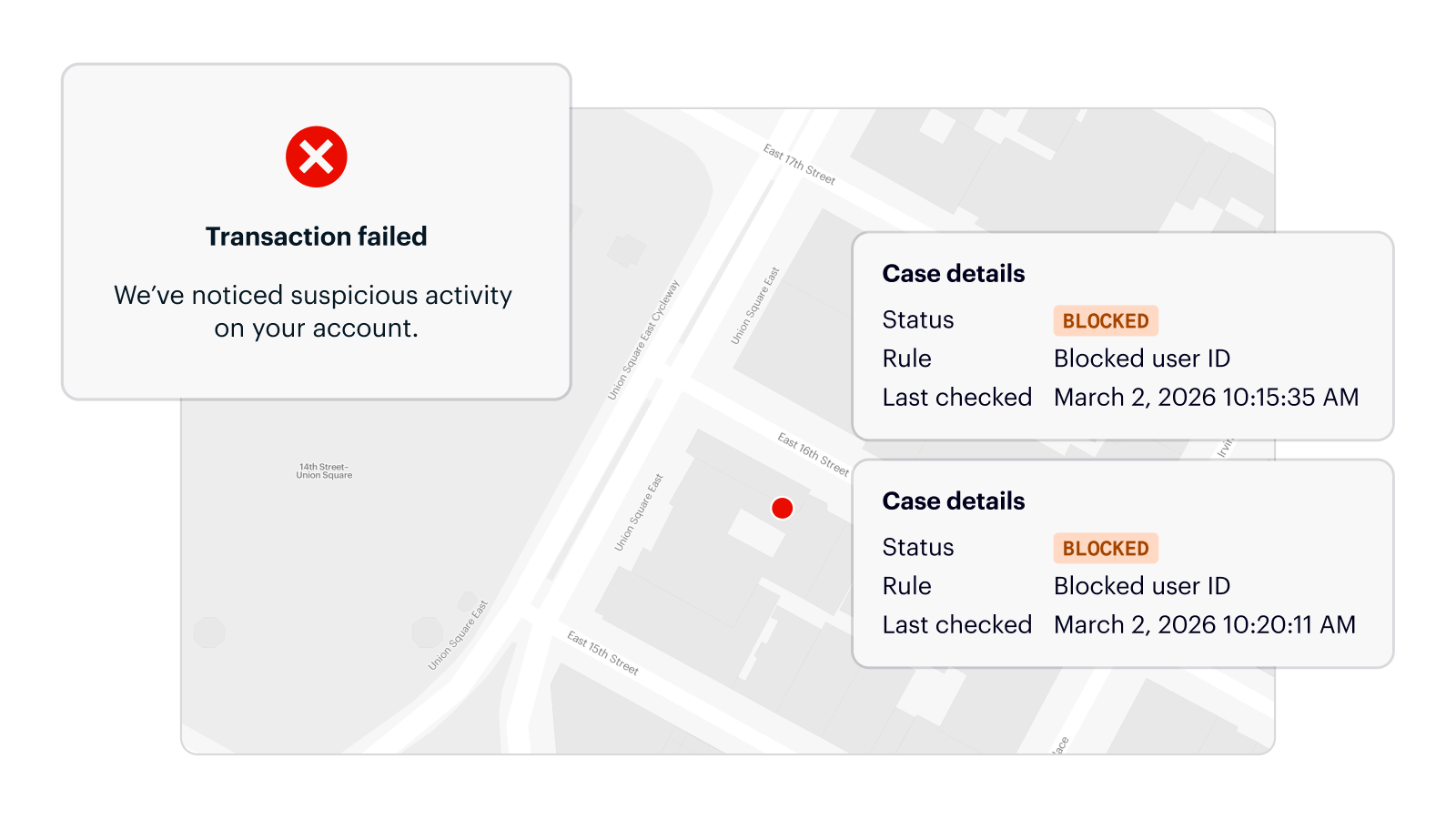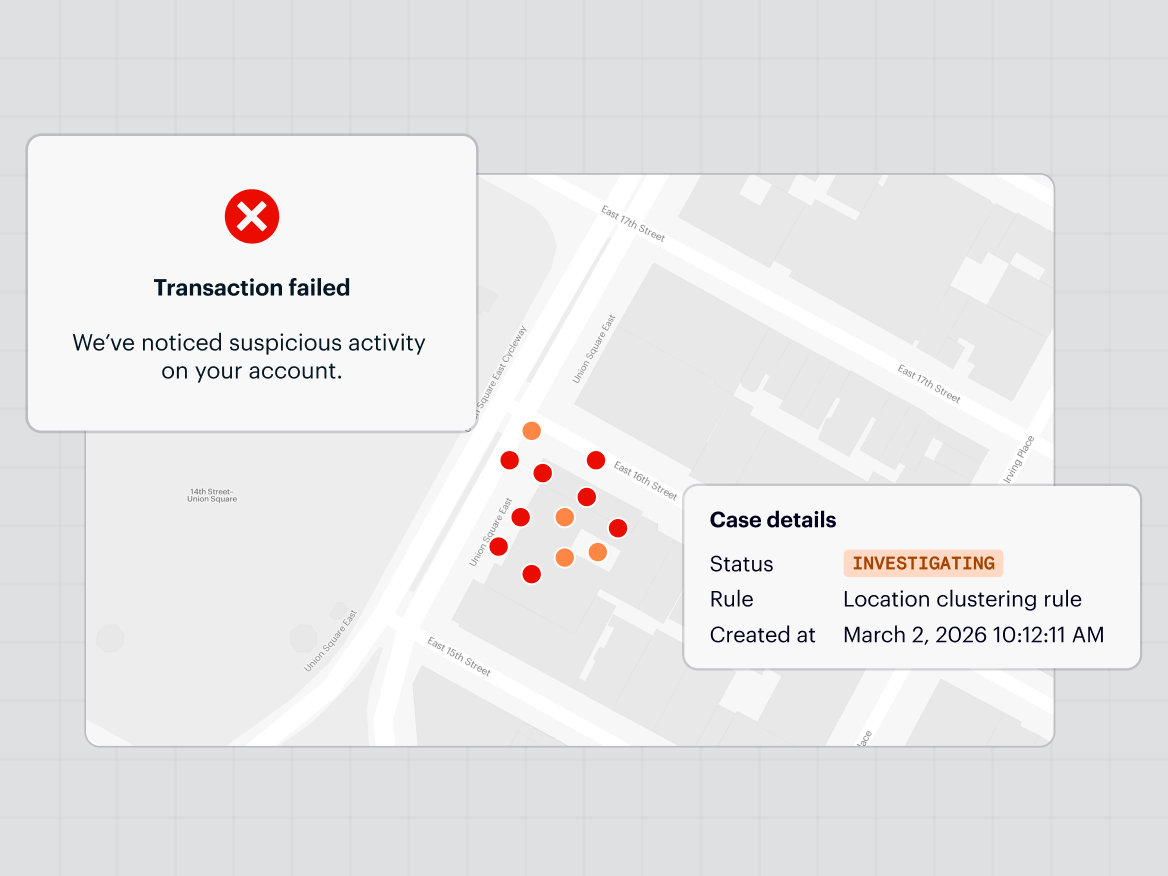
A courier marks twelve deliveries complete in a single afternoon, all from a phone that, according to its own GPS, hasn't moved from a one-bedroom apartment in Newark. The orders were real. The pickups weren't. Someone ran a mock location app, queued the routes, and collected the completion payouts without driving anywhere.
The reason this works is specific to mobile. Your app doesn't observe where a user is, it asks the device's operating system, and it trusts whatever comes back. On a phone, that reported location can be fabricated at the OS level, so the coordinate your app receives looks completely normal while describing a place the user has never been. Identity verification and IP checks don't close this. You can confirm a user is who they claim, run their device against a reputation database, and still have no idea the location the OS handed you is fake.
The cost shows up as courier payout fraud, bonus and promo abuse from accounts pretending to be in eligible regions, chargebacks tied to transactions that didn't happen where the data says, and regulatory exposure when a user places a bet or buys a restricted product from a jurisdiction where you aren't licensed to serve them. Preventing it comes down to two moves:
- Verifying that the location the device reports is real
- Enforcing that check at the moment an in-app action depends on it
The advantage you have is that the same phone the fraudster lies through is a device full of sensors and signals you can verify against, which is something a server-side check looking at IP alone never gets to see.
How location spoofing happens
Every method starts from the same weakness: the app trusts what the operating system reports, and on a mobile device that report can be manipulated. The methods differ in how much technical effort they take and how cleanly they pass through standard checks, which matters because a defense tuned for one will miss the others.
Mock location is the lowest-effort path. Android exposes a developer setting that lets an app supply coordinates to the system, and any of dozens of free apps will feed a fake position to every other app on the device. The reported GPS looks normal because, as far as the OS location API is concerned, it is normal. Nothing about the coordinate itself gives it away.
GPS spoofing apps go a step further by simulating movement, not just a static point, which defeats systems that only flag a location for being implausibly still. Emulators drop the physical phone entirely, running your app on a desktop that pretends to be a mobile device. A fraudster on an emulator can script location, identity, and behavior across hundreds of instances, which is the engine behind most multi-accounting and device-farm operations. VPNs and residential proxies handle the network layer, masking the true IP so that anything relying on IP geolocation reads the proxy's exit node instead of the user. SIM and timezone data add another seam worth watching, since a device reporting a German SIM, a US IP, and a clock set to Manila is telling you three different stories about where it is.

The takeaway for prevention is that no single signal is sufficient. A spoofed GPS coordinate is internally consistent. The fraud surfaces in the contradictions between what the device reports across its signals, and in patterns that emerge over time rather than in any one session.
Why identity and IP tools miss it
Most fraud stacks already verify identity and check IP. Both leave the location gap open.
Identity verification answers whether a user is who they claim. It says nothing about where they are. A fraudster with a stolen-but-valid identity, or a real user abusing a legitimate account, clears identity checks and still spoofs location freely. The two questions don't overlap.
IP geolocation looks like it covers location, and for casual cases it does. Residential proxies break it. A proxy routes a user's traffic through a real residential IP in whatever city they need to appear in, so the IP resolves to a clean, plausible location with no datacenter signature to flag. The user sits in Lagos and reads as Newark. IP-based location was built to approximate where traffic originates, not to resist someone actively working to defeat it, and the tooling to defeat it costs a few dollars a month. It also lives at the network layer, which means it never sees what the device itself could tell you.
This is why location verification works as an added layer rather than a replacement. Identity tells you who, the device tells you where, and the fraud that slips through is the fraud that's consistent on one axis and lying on the other.
How to verify location and catch spoofing
The thing that makes mobile location fraud solvable is that the device is more than a coordinate. It's a phone with an OS state, motion sensors, and a history, and verification reads all of that rather than trusting the single number the OS reports. Three layers do most of the work, and each points to something you can act on.
1. Device integrity
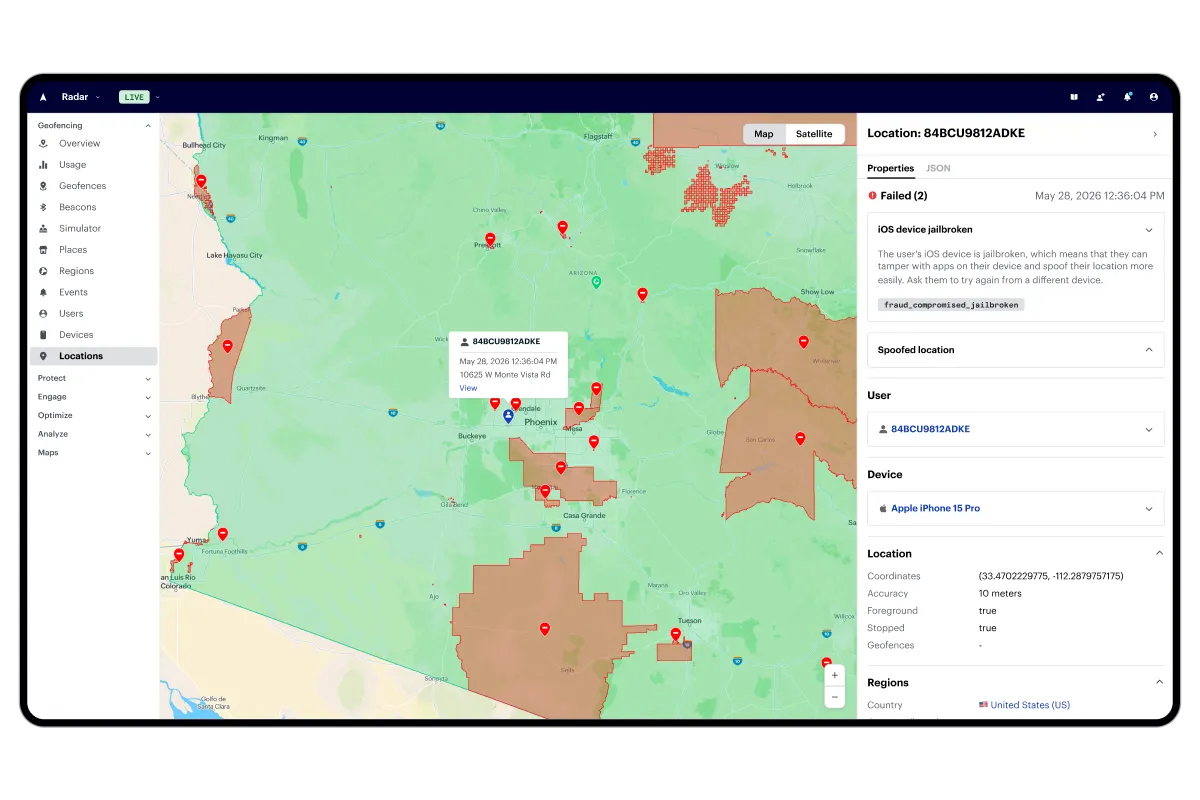
Before you evaluate where a device claims to be, you establish whether the device itself is being honest: whether mock location is enabled, whether the OS is rooted or jailbroken, whether the app is running on real hardware or inside an emulator. A device with mock location turned on isn't automatically fraudulent, but it's a different risk tier than one without. The preventive move is to act on that tier before the device completes an action, whether that means blocking it, stepping up to another check, or flagging it for review.
2. Geofence and movement analysis
A real phone moving through real space produces a coherent trail: dwell time at a pickup location, transit between points that matches plausible travel speed, motion-sensor data that lines up with the GPS track. Spoofed locations tend to teleport, sit too still, or move at speeds no car achieves, and they often don't match what the device's other sensors report. This is where verification turns into enforcement, since you can require that a courier's phone actually register inside a merchant's geofence before a pickup counts, instead of accepting a self-reported coordinate.
3. Behavioral consistency over time
Single-session checks catch the careless, but the persistent fraud shows up across sessions: the same device cycling through locations that don't form a believable pattern, accounts that share a device fingerprint while claiming to be in different cities, login locations that contradict transaction locations. This is the layer that separates a one-off anomaly from an organized operation, and acting on it means tightening enforcement on an account as its history accumulates contradictions rather than judging it at a single moment.
For the full signal-by-signal breakdown, including how each detection method maps to specific fraud types, see our guide on how to detect location spoofing.
How geofencing and real-time location enforce the check
Verification tells you a location was faked. Enforcement stops the in-app action that depended on it. Geofencing and real-time location are how a verified location becomes a control rather than a log entry.
A geofence is a defined boundary that the app evaluates the device against. Used as a control rather than a marketing trigger, it lets you require a verified physical presence before an action counts. A courier's phone has to actually register inside the merchant's geofence, confirmed against the device-integrity and movement signals already described, before a pickup is accepted. A bet only clears if the player's phone confirms inside the licensed boundary at the moment of the wager.

Real-time location updates are what make this hold up against evasion. A single location check at one moment is a snapshot a spoofer can stage. Continuous updates from the device produce a trail, and a trail is far harder to fake convincingly, because the fraudster has to keep a fabricated position internally consistent across every reading, through transitions, at plausible speeds, for the full duration of the session. Most spoofing setups break somewhere in that sequence.
Building location fraud prevention into your app
Verification and enforcement only prevent fraud if they fire at the right moments and trigger the right response. Three decisions shape whether the control works.
1. Where to verify
Checking location once at signup tells you nothing about where the user is when they place a bet three weeks later, and checking on every background ping wastes signal and battery on moments that carry no risk. Tie verification to the in-app actions that actually carry exposure: account opening, a transaction above a threshold, a courier marking a pickup, a wager, a promo redemption. Those are the points where a faked location turns into a loss, and they're where the check belongs.
2. How to respond when a check fails
A hard block on every flagged device is the blunt option, and it costs you real users whose only crime is a rooted phone or a VPN they forgot was on. Tiering the response works better: a low-risk anomaly steps up to another signal, a medium-risk one holds the action for review, a high-risk combination of mock location plus a contradicting movement history blocks outright. The point is to match the friction to the risk rather than treating every failed check as fraud.
3. What you do with history
Location fraud prevention gets stronger the longer you observe an account, because a single session rarely proves intent while a pattern does. Feeding verification results back into the account's risk profile means the device that spoofed once gets watched more closely the next time, and the operation running fifty accounts off one device fingerprint surfaces even when each individual session looks clean. Prevention isn't a gate at one moment, it's a profile that sharpens over time.
What to enforce by app type
The mechanics of spoofing are constant across mobile apps. What changes is the in-app action worth protecting, which is what determines where you put the check.
In fintech, the points to protect are account opening and transactions that contradict an account's established geographic pattern. Verifying location at onboarding stops accounts created from spoofed locations to sidestep regional eligibility, and a transaction geo that breaks pattern is the trigger for a step-up check. Know-your-customer obligations raise the stakes on getting the onboarding check right.
In iGaming, the check to enforce is presence inside the licensed boundary at the moment of the wager, not at signup. The fraud and compliance signals are the same signal read for two purposes: the player crossing a state line to place a bet is both a licensing violation and a user actively evading your controls, and the geofence at bet placement stops both.
In delivery, enforce a confirmed geofence entry before a pickup or dropoff counts, and run it both directions. Couriers spoof to claim deliveries they didn't make and to appear inside high-demand zones, and merchants spoof to qualify for placement or incentives tied to a location. Gating the payout on verified presence removes the reward.
In marketplaces, the thing to catch is the shared device fingerprint underneath many accounts. A single operator running multiple seller or buyer accounts uses spoofed locations and emulated devices to make each look like a distinct person in a distinct place, so device-integrity checks at account creation and login are what unwind the operation before it scales.
When location fraud is also a compliance failure
For some apps, enforcing a location check isn't only a fraud control. It's a licensing requirement, and getting it wrong carries penalties that dwarf the fraud loss.
iGaming is the clearest case. An operator licensed in New Jersey can't legally accept a wager from someone physically in Pennsylvania, regardless of where that user's account was opened or where their payment method is registered. The obligation is continuous: the operator has to confirm the player is inside the licensed boundary at the moment of the bet, not just at signup, which is exactly the moment a VPN or mock location app is built to falsify. Sweepstakes and promotional contests carry their own eligibility-by-geography rules, where a single ineligible winner can void a promotion. The same logic reaches any app serving region-restricted products, where fulfilling an order into a jurisdiction you're not cleared for turns a sale into a liability.
The throughline is that compliance-grade location verification has to survive deliberate evasion, because the user spoofing their location to clear a licensing boundary is often the same user a fraud team would flag anyway. The signals that catch a courier faking deliveries are the signals that catch a player crossing a state line. The difference is the consequence: one is a payout you shouldn't have made, the other is a regulator asking why you accepted a bet you weren't licensed to take.
How Radar helps
Radar provides the on-device location layer this guide describes: device-integrity checks that flag mock location, rooted and jailbroken devices, and emulators; geofencing that enforces verified presence at the moment an action happens; and continuous location updates that expose the inconsistencies spoofing produces over time. It runs alongside the identity and IP tools already in a fraud stack rather than replacing them, adding the where to the who those tools establish.
Whether that layer is worth adding depends on where location sits in your fraud and compliance exposure. An app with no geography-dependent risk doesn't need it. An app losing money to courier payout fraud, leaking bonus spend to multi-accounting, or carrying licensing obligations tied to user location has a gap that identity and IP tools structurally can't close, and that's the gap this fills.
To see how location verification maps to your specific fraud types, book a demo.
Frequently asked questions
How do you prevent location fraud in a mobile app?
Location fraud prevention combines two moves: verifying that the location the device reports is genuine, and enforcing a check at the moment an in-app action depends on it. Verification reads device integrity, motion and movement patterns, and behavioral consistency rather than trusting the single coordinate the OS reports. Enforcement requires a confirmed location, often a geofence entry, before a payout, bet, or transaction clears. The check should fire at the actions that carry exposure and tier its response to the level of risk.
What is location spoofing detection?
Location spoofing detection is the process of determining whether a device's reported location is genuine or falsified. It works by reading location as a set of corroborating signals, device integrity, movement patterns, and behavioral consistency over time, rather than trusting a single reported GPS coordinate, which is trivial to fake on a mobile device.
What is location spoofing, and how do fraudsters do it?
Location spoofing is the act of falsifying a device's reported geographic position. On mobile, fraudsters do it through mock location settings, GPS spoofing apps that simulate movement, emulators that pretend to be a real phone, and VPNs or residential proxies that mask the true IP. Each method passes through different checks, which is why detecting one doesn't catch the others.
How is location verification different from IP geolocation?
IP geolocation approximates location from the network address, which residential proxies defeat for a few dollars a month by routing traffic through a real IP in the target city. Location verification reads device-level and behavioral signals that a proxy doesn't touch and that a network-layer check never sees, which is why it holds up against users actively working to evade it.
What is geolocation compliance, and which apps need it?
Geolocation compliance is the obligation to confirm a user is physically within a permitted jurisdiction before delivering a regulated action. iGaming operators need it to enforce state-by-state licensing, sweepstakes need it for eligibility, and any app serving region-restricted products needs it to avoid fulfilling into jurisdictions it isn't cleared for.
How accurate is geofencing for fraud prevention?
Geofencing accuracy depends on the underlying location signals and how the boundary is enforced. Used as a fraud control, its value comes less from pinpoint precision than from requiring a verified physical presence, corroborated by device-integrity and movement data, before an action counts, which is what a spoofed coordinate alone can't satisfy.
Can location fraud be prevented in real time?
Yes. Real-time location updates let an app confirm presence at the moment an action happens rather than relying on a single earlier check, and continuous updates make spoofing harder to sustain because a fabricated location has to stay internally consistent across every reading for the full session.