
Quick summary
Marketplace platforms don't have one fraud problem. They have a trust problem that shows up differently across every category.
A resale app has to stop counterfeit sellers and fake listings. A rental marketplace has to verify that properties and hosts are real. A services marketplace has to keep banned providers from coming back under new accounts. A ticketing platform has to stop bots from buying inventory before real users can.
The tooling to catch each pattern varies, but the common thread is the same: marketplace fraud happens in the gap between what the platform thinks is happening and what's actually happening in the real world.
A listing may look local. A seller may look new. A review may look real. A buyer account may look legitimate. But the fraud becomes visible when platforms connect device, location, account, and behavior signals across the marketplace.
Here are the five most common fraud patterns hitting marketplace platforms right now, what each one costs, and what it takes to catch them.
1. Fake listings and seller fraud
Fake listings are the most universal fraud pattern across marketplace categories, and the mechanic is consistent regardless of platform type. A fraud ring posts a listing that looks legitimate, collects a deposit or payment from a buyer who trusts what they see, and disappears before the transaction completes.
On car-sharing marketplaces, this can look like fake luxury car listings. A fraudster posts a high-end vehicle they don't own, collects a deposit from a renter, and the listing vanishes. On rental platforms, fake vacation properties collect booking payments from travelers who show up to find the property doesn't exist or isn't available. On resale platforms, counterfeit or nonexistent products get listed with stolen images and shipping labels that never move.
The location mechanic is what makes these listings believable. Fake listings are often spoofed to appear local. A seller who claims to be two miles away triggers a trust response in buyers that a seller across the country wouldn't. The proximity signal is the hook.
The cost of fake listings isn't limited to reimbursing one buyer. A fake listing can trigger refunds, support escalations, chargebacks, trust and safety review, seller takedowns, and reputational damage. In short-term rentals, the exposure can be even larger. Federal prosecutors charged one operator in an Airbnb and Vrbo bait-and-switch scheme that allegedly generated more than $8.5 million through misleading listings, double bookings, aliases, and review manipulation.
Review manipulation often travels with fake listings because marketplaces run on trust signals. If a fraudulent seller can hide negative reviews, relist under a new profile, or manufacture positive reviews, the listing becomes more believable. The FTC's fake review rule, which went into effect in October 2024, lets the agency seek civil penalties against businesses that knowingly buy, sell, or use fake reviews, including AI-generated reviews or reviews from people without real experience.
How to catch fake listings
Platforms catching fake listings effectively are verifying the seller, device, and location before the listing goes live. That includes signals like:
- Device location at listing creation
- Listings posted from spoofed, emulated, or previously flagged devices
- Location mismatches between seller profile, listing address, and device behavior
- Repeated listing patterns tied to the same device, image set, or account cluster
The goal is to catch the risk before buyers ever see the listing, not after someone has already paid for something that doesn't exist.
2. Multi-accounting
Multi-accounting on marketplace platforms usually shows up in two patterns. The first is ban evasion: a seller gets deactivated for policy violations, creates a new account, and picks up where they left off. The second is reputation laundering: a seller with low ratings or negative reviews creates a fresh account to start over with a clean slate.
On services platforms, this can be especially damaging. A contractor deactivated for quality issues or fraud can return under a new account and continue taking jobs from customers who have no way of knowing they're dealing with the same operator. On resale platforms, deactivated sellers can return to move counterfeit inventory or run the same scam that got them flagged the first time.
Multi-accounting is expensive because the fraud isn't always inside one account. It's in the relationship between accounts. A new seller may look clean until the platform connects that account to a previously banned device, location, payout method, or behavior pattern.
Research on organized ecommerce fraud supports this point. In one study, researchers found that looking at each order in isolation missed coordinated fraud groups. By clustering linked activity, they were able to group 35% to 45% of fraudulent orders and detect 26.2% of fraud while creating false alarms for only 0.1% of legitimate orders.
That's why account-level review alone doesn't work. The question isn't only whether the new account looks legitimate. It's whether the device behind it has been here before.
There's also a broader account economy behind this behavior. Academic research into social account marketplaces found 38,253 accounts advertised for sale across 11 marketplaces, with total marketed account value exceeding $64 million. This highlights that fraudsters don't always have to create every account themselves. They can buy, reuse, rotate, and resell account infrastructure.
How to catch multi-accounting
Platforms catching multi-accounting effectively are looking for account relationships that don't make sense for a normal seller or buyer. That includes signals like:
- The same device associated with multiple accounts
- New accounts created from the same location cluster as banned accounts
- Repeated use of the same emulator, VPN, proxy, or payout infrastructure
- Seller behavior that matches a previously deactivated account
The earlier this detection happens in the account lifecycle, the less exposure the platform carries. Ideally, platforms are identifying linked accounts before the new account gets its first listing, booking, job, or payout approved.
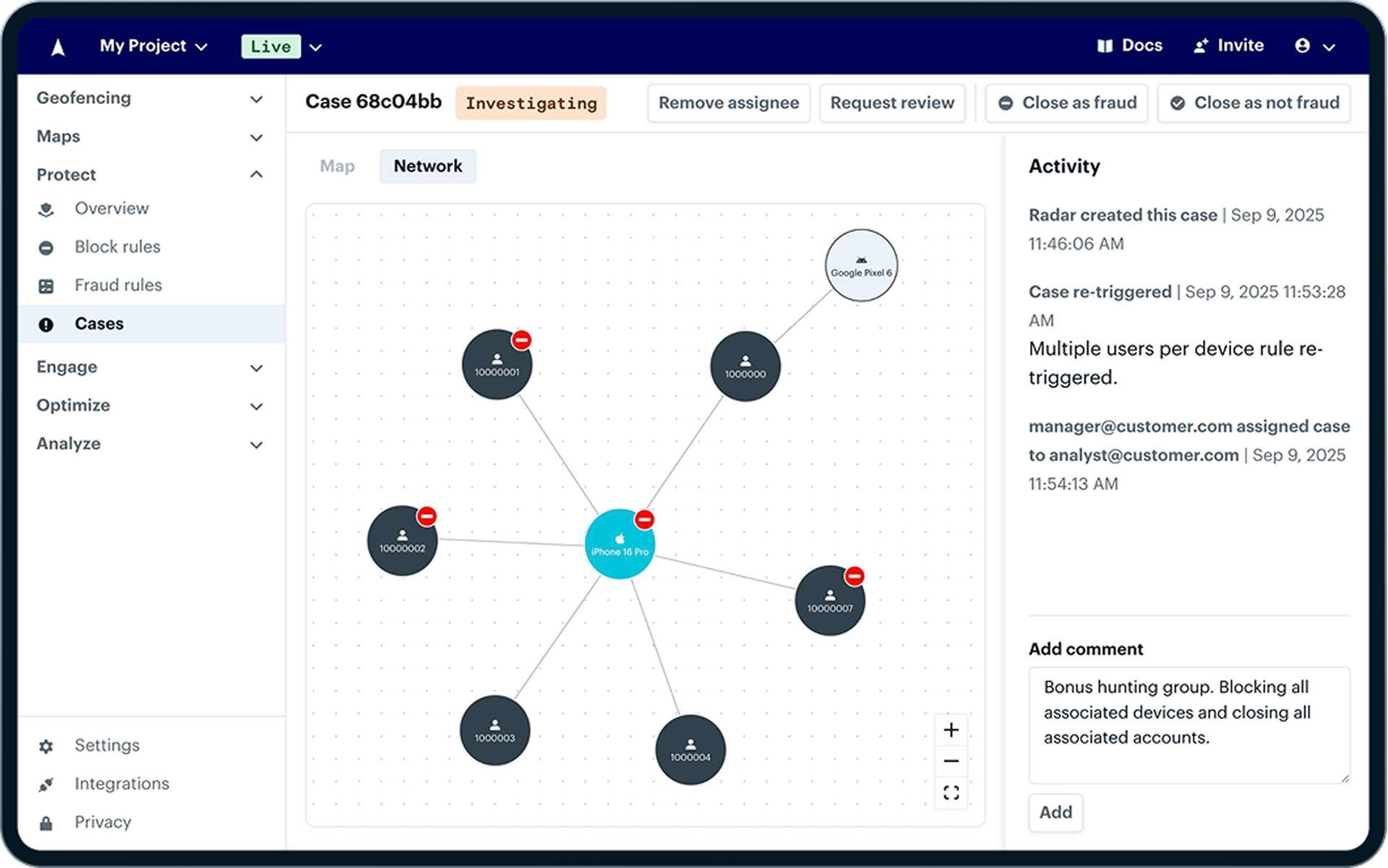
3. Bonus and promo abuse
Most marketplace platforms run acquisition programs for new sellers. Free listing credits, new seller boosts, referral incentives, and first-booking credits are standard tools for building supply in competitive markets. They're also a consistent target for fraud rings.
The operation is straightforward. A ring creates multiple seller accounts using shared device infrastructure and synthetic or stolen identities, claims the new seller bonus on each one, and moves on. On platforms where referral incentives pay out on both sides of a transaction, the same ring can create buyer accounts to complete fake transactions and trigger the referral payout.
The direct loss is the promotional leakage. The less visible cost is what it does to acquisition data. The platform thinks it's building real seller supply. Instead, it's paying a fraud ring to create disposable accounts that may later be used for fake listings, multi-accounting, inventory manipulation, or review abuse.
Promo abuse also isn't always a simple coupon problem. In marketplaces, incentives can be used to manufacture fake supply, fake engagement, fake ratings, or fake transactions. FTC reporting on task scams shows how costly paid-action abuse can become: these scams stole more than $220 million in the first half of 2024 by getting victims involved in fake app optimization, product boosting, ratings, or likes. The FTC also reported 20,000 task scam reports in the first half of 2024, compared with 5,000 total reports from 2020 through 2023.
For marketplaces, the lesson is direct: when incentives reward account creation, ratings, listings, referrals, bookings, or transactions, fraud rings will look for ways to manufacture those actions at scale.
How to catch bonus and promo abuse
Platforms catching bonus and promo abuse effectively are looking for shared infrastructure before the first incentive pays out. That includes signals like:
- Multiple accounts created from the same device, emulator, or location cluster
- Referral chains with repeated device or location overlap
- New accounts that trigger promo-eligible actions in unusually similar patterns
- Campaign-window spikes tied to the same IP range, VPN, proxy, or device network
The goal is to catch the relationship between accounts in real time, not audit payout patterns after the money has already moved.
4. Device farms and bot activity
Device farms on marketplace platforms aren't just about creating fake accounts. They're about coordinated manipulation of platform mechanics at scale.
On ticketing platforms, bot farms run automated scripts to buy presale inventory in bulk within seconds of availability, then immediately relist tickets at multiples of face value. On reservation and booking platforms, automated no-show reservations can manipulate inventory or extract fees. On review-driven marketplaces, bot networks can generate fake reviews at industrial scale to inflate ratings for paying clients or suppress competitors.
What makes device farms different from individual fraud is the automation and coordination. Each account in the network can look normal in isolation. The pattern only becomes visible when you look at the device layer and see the same infrastructure behind hundreds of coordinated actions happening in the same window.
Ticketing shows the business impact clearly. In the FTC's first BOTS Act case, three New York-area ticket resellers were subject to a judgment of more than $31 million, partially suspended to require $3.7 million in payment, after allegedly using bots to bypass ticket limits and resell inventory.
Device farms also hurt marketplace health. Real users lose access to inventory. Legitimate sellers and buyers lose trust in the platform. Operations teams end up cleaning up abuse after the marketplace mechanics have already been manipulated.
How to catch device farms and bot activity
Platforms catching device farms effectively are identifying automation before the high-risk action completes. That includes signals like:
- Emulated or automated devices at account creation or purchase
- Coordinated actions across many accounts in the same time window
- Shared device characteristics across accounts that appear unrelated
- Location behavior that doesn't match normal human marketplace activity
The goal is to stop the device or bot network before it can create accounts, claim inventory, submit reviews, or trigger marketplace actions at scale.
5. Account takeover
Account takeover is less of a systemic problem on marketplace platforms than it once was. MFA and device fingerprinting have made it harder to execute at scale, and most platforms have layered in step-up authentication at sensitive moments.
But on high-trust marketplace platforms, the per-incident exposure is high enough that it still warrants a dedicated detection layer. A hijacked host account can redirect rental payouts to an attacker-controlled bank account. A compromised seller account can message buyers from a trusted profile. A compromised real estate or services account can be used to intercept high-value transactions or redirect payments.
ATO may be less frequent than fake listings or multi-accounting, but the per-incident exposure can be much higher. FBI-linked reporting says account takeover scams caused more than $262 million in losses in 2025 so far, across more than 5,100 complaints. For high-trust marketplaces, the risk isn't only that an attacker logs in. It's what they do next: change payout details, redirect funds, message buyers from a trusted account, or intercept a high-value transaction.
That's why broad login friction isn't the answer. The intervention point is login and the moment before a sensitive account change. A verified account suddenly appearing on a new device in a new city, followed by a bank account update or payout redirect, is the pattern worth catching.
How to catch account takeover on marketplace platforms
Platforms catching ATO effectively are checking device and location at login and before sensitive account changes. That includes signals like:
- A trusted account suddenly logging in from a new device or location
- Impossible travel between recent sessions
- Bank account, payout, email, or phone changes after a risky login
- High-value listing, booking, or message activity immediately after account access
The goal is to apply friction when the risk is real, not across every session. Good users should be able to keep moving. Risky sessions should get stopped before an attacker can change where the money goes.
Using location signals to detect marketplace fraud
The five fraud patterns in this piece look different on the surface. Fake listings, multi-accounting, bonus abuse, device farms, and account takeover are distinct mechanics with distinct financial consequences. But they all share the same detection gap: they're not visible to tools that look only at identity and transaction signals.
Fake listings spoof location to appear local. Multi-accounting returns on the same device. Bonus abuse operates from the same location cluster. Device farms run from emulated environments. Account takeover appears on a new device in a new city. These are all location and device signals, and they're all catchable before the damage is done.
Getting the tools to help
Most marketplace platforms dealing with these patterns are relying on tools that weren't built to catch them. IP geolocation that proxies defeat in seconds. Homegrown solutions that don't scale. Many don't fully understand the extent of their exposure until a buyer dispute, a regulatory inquiry, or a press story about fake listings forces the issue.
Radar Protect is built for the layer where this fraud actually lives. It uses precise GPS verification, location spoofing detection, and environment fingerprinting, including ambient signals like Wi-Fi and Bluetooth, to verify that a device is actually where it claims to be. It complements existing fraud stacks and sits inside the same platform teams already use for geofencing, address validation, and maps.