Radar is evolving from location infrastructure to location intelligence.
Geofencing and Maps showed us the value of connecting digital products to the physical world. But for many enterprises, the harder problem isn‘t simply knowing where something is, it‘s knowing what to trust and what to do next.
Can I trust this transaction? Is this on schedule? Is this user actually nearby?
Radar is evolving to answer those questions: turning location data into intelligence that powers mission-critical decisions.
Our brand was built for Radar‘s previous chapter and needed to evolve with the next one. So we set out to create a system that reflects where the company is going, while preserving what has always made Radar feel like Radar.
This post covers the strategy behind the refresh, the system we designed, and how a new way of working brought brand and product closer together.
The evolution
In October 2025, we expanded Radar beyond Geofencing and Maps with three new solutions: Protect for anti-fraud and geo-compliance, Optimize for operations and workforce management, and Engage for location-based marketing and personalization.
That evolution broadened our role: from providing location infrastructure to helping customers use location intelligence to make better decisions.
Our brand needed to catch up, building greater trust and credibility with enterprise audiences without losing the developer-friendliness at our core.
We aligned on two principles for the refresh:
- Build for scale. Create one design system across brand and product that works for internal teams and scales across industries and audiences.
- Keep our core DNA. Our intelligence is only as good as the infrastructure beneath it. Preserve the reliability, accuracy, and developer-friendliness that have always differentiated Radar.
That also meant evolving our brand ethos from Location Visionaries to Location Experts. Visionaries was about imagining and building better location-based experiences. Experts is more about helping customers make smarter, higher-stakes decisions with location.
Trusted. Intelligent. Powerful.
Those attributes became the lens for the new system.
From strategy to system
We started with a moodboard exercise exploring a wide spectrum of directions that leaned into specific attributes. We eventually narrowed the field to a single creative concept, Synthesis. It captured the idea of interpreting data to unlock meaningful patterns and insights with the power and precision of layered systems and infrastructure. It‘s both technical and dynamic. This guided the visual direction.
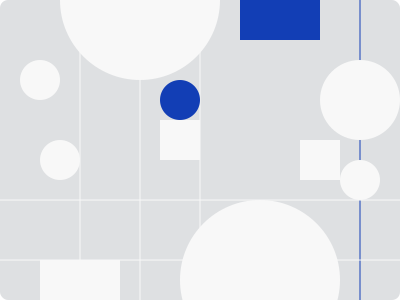
From there, we explored several visual concepts and combined the strengths into one direction, a coordinate system. The dots represent location data and signals. It‘s a framework for defining the position of any point in space, built to adapt and communicate technical concepts, product features, and brand ethos across evolving media.
The result is a clean, modern, and powerful system. And because it‘s built to adapt, it scales across media by design rather than as an afterthought.
Proving out the design system
We spent a few design cycles exploring sample applications to flesh out the visual direction, but quickly moved into proving out the design system in real time with real touch points. A design system only earns trust when it holds up in actual application. It was important to move with the high-velocity pace and needs of the business.
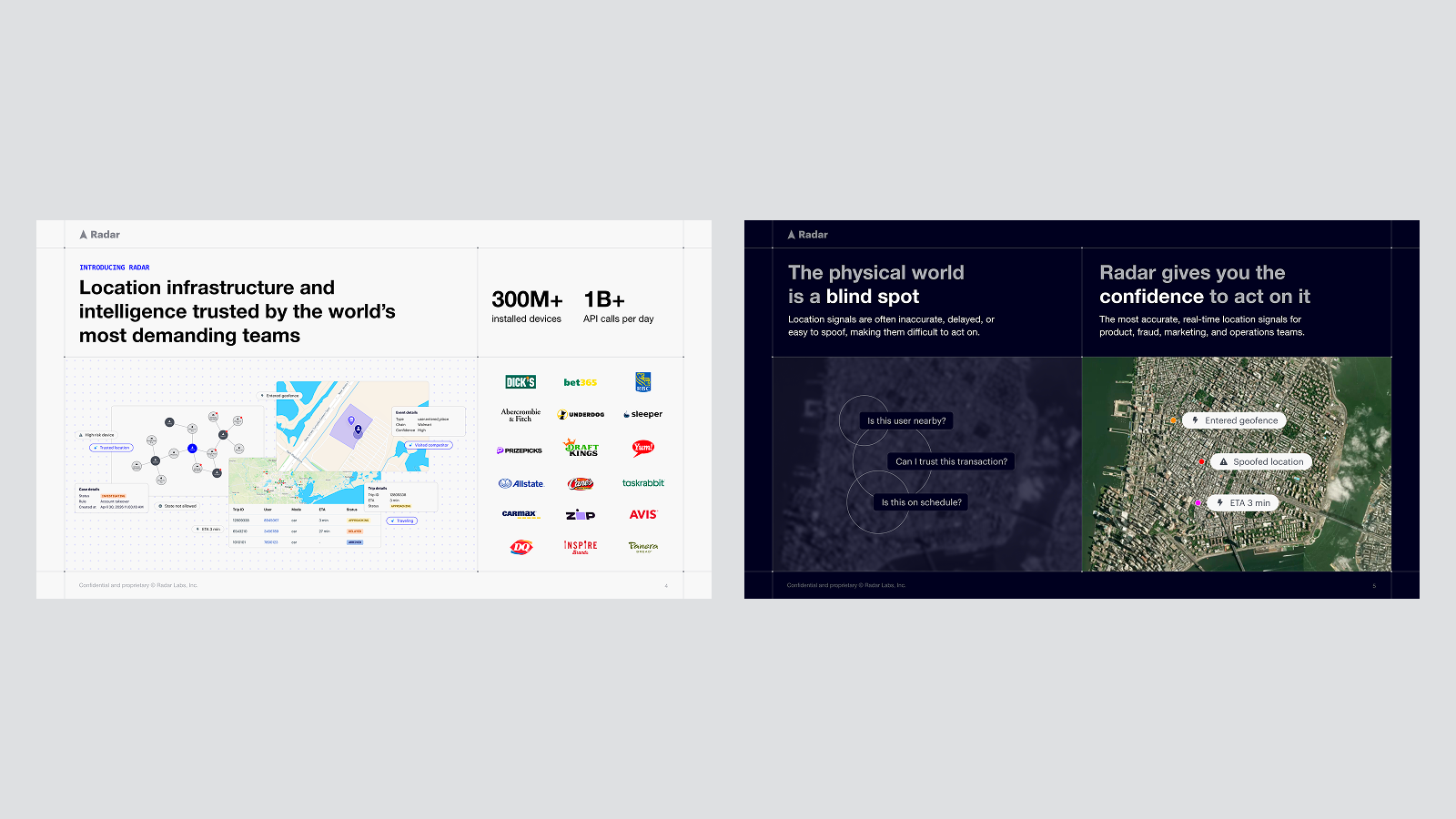
The first external touch points for the refresh are key pages of the marketing site and sales deck. These are the core surfaces of the business, and leading with them was deliberate to empower our go-to-market teams.
This was followed by Reveal, our first product launch campaign built on the refreshed brand. It‘s a fraud-detection API that reads device and network signals across every web and mobile session and returns a low, medium or high risk score.
From a design lens, Reveal is a product where the work happens in code. There is no new dashboard UI to feature or highlight. Data goes in, a risk signal comes out, driven by code and logic most people will never see.
So when the product launch called for a landing page, we decided to demonstrate the product with a widget built on an API that Engineering was still developing in parallel. It reads the visitor‘s own device and network signals and returns a risk score, so the page runs a real session instead of illustrating one. It had to be technically accurate, easy to grasp, and visually memorable. An abstract technical concept the new design system was created for and a perfect example of how brand and product were brought closer together.
The Reveal campaign is a microcosm and culmination of how our Design team worked from the early stages of the brand refresh process. We were nimble and experimented with the latest AI tools available, from concepting ideas to shipping code. This way of working didn‘t exist for us even a year ago.
Design in motion
The brand refresh gives us one design system that scales from internal enablement to external awareness, and a differentiated positioning for the enterprise audience without losing the developer DNA authentic to Radar. It was a process where the team embraced designing in code and proving out the system in real applications that matter, rather than on mockups that don‘t have to hold up.
A lot of work is still in motion, including an internal design resource site to enable our internal teams as well as showcase more of the work we‘re proud of. The foundation is set, and it‘s a design system that is built for where Radar is going. If this kind of work excites you and you thrive on taking outsized challenges with real business impact, let‘s talk. We‘re looking for exceptional design talent to join our team.