Radar processes more than 100 billion precise location observations per year from over 500 million devices. From gaming to retail to financial services, our location infrastructure and intelligence platform powers mission-critical compliance and fraud decisions and best-in-class experiences across hundreds of enterprises.
This scale gives us a unique advantage: a continuously improving understanding of the physical world.
Today, we're introducing the Location Intelligence Graph, a proprietary data and machine learning foundation that helps us turn these observations into more accurate location data, smarter fraud risk scores, and insights that others can't match.
Better location intelligence, powered by better data
The Location Intelligence Graph connects location observations with geographic, device, and network signals to identify patterns that would be difficult to detect from any individual signal.
For example, a device might report a plausible location, but its sensor data, network characteristics, or history might suggest otherwise. Multiple seemingly unrelated accounts might also exhibit suspicious activity at the same physical location.
By analyzing these relationships at scale, the Graph helps Radar distinguish legitimate activity from location spoofing, device farms, multi-accounting, and other types of fraud.
And because Radar powers location use cases across verticals, we have an unusually broad set of signals to learn from.
Our Geofencing SDKs collect precise location observations across hundreds of millions of devices. Our Maps Platform provides geographic context through geocoding, places, and boundaries. And our fraud and geo-compliance products contribute insights into device integrity, location authenticity, and suspicious activity.
Together, these capabilities create a data advantage that gets stronger as our platform grows.
Introducing fraud hotspots and RF-1
Today, we're bringing the Location Intelligence Graph to life with two new capabilities:
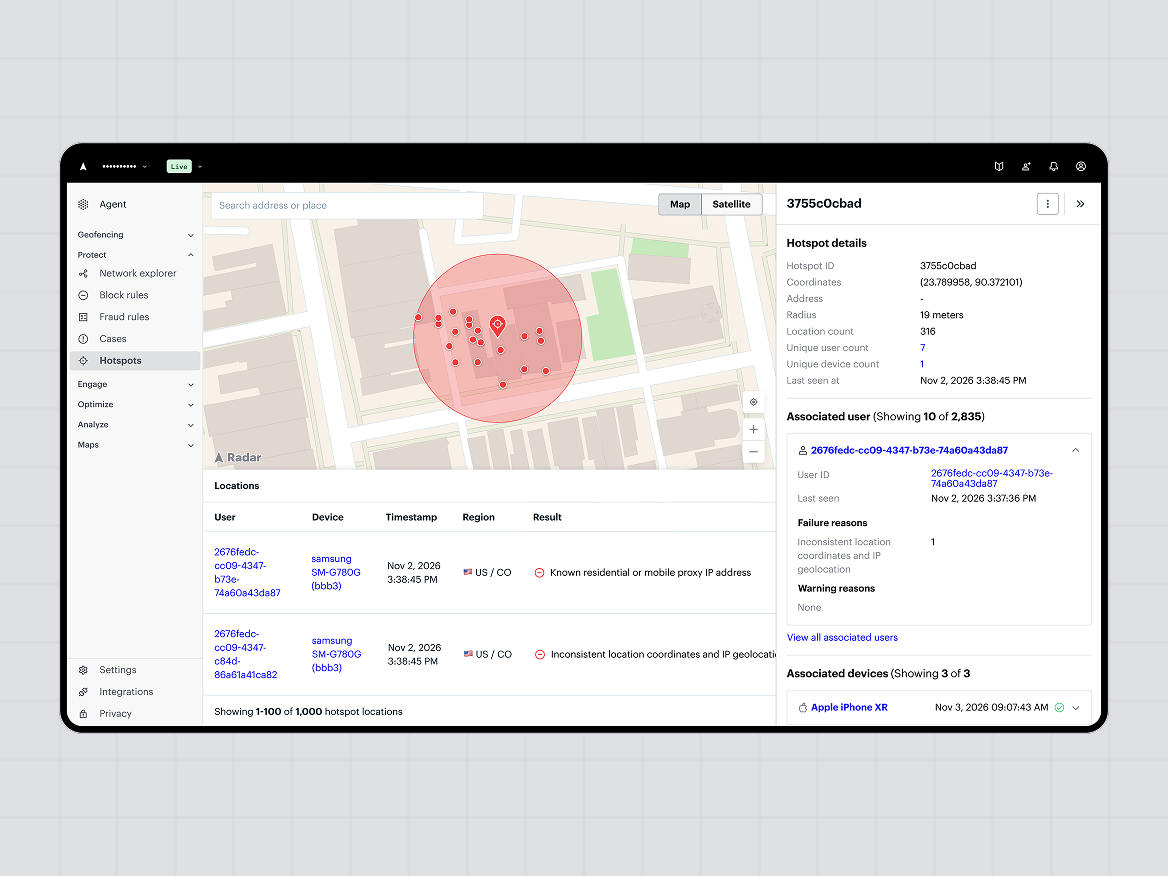
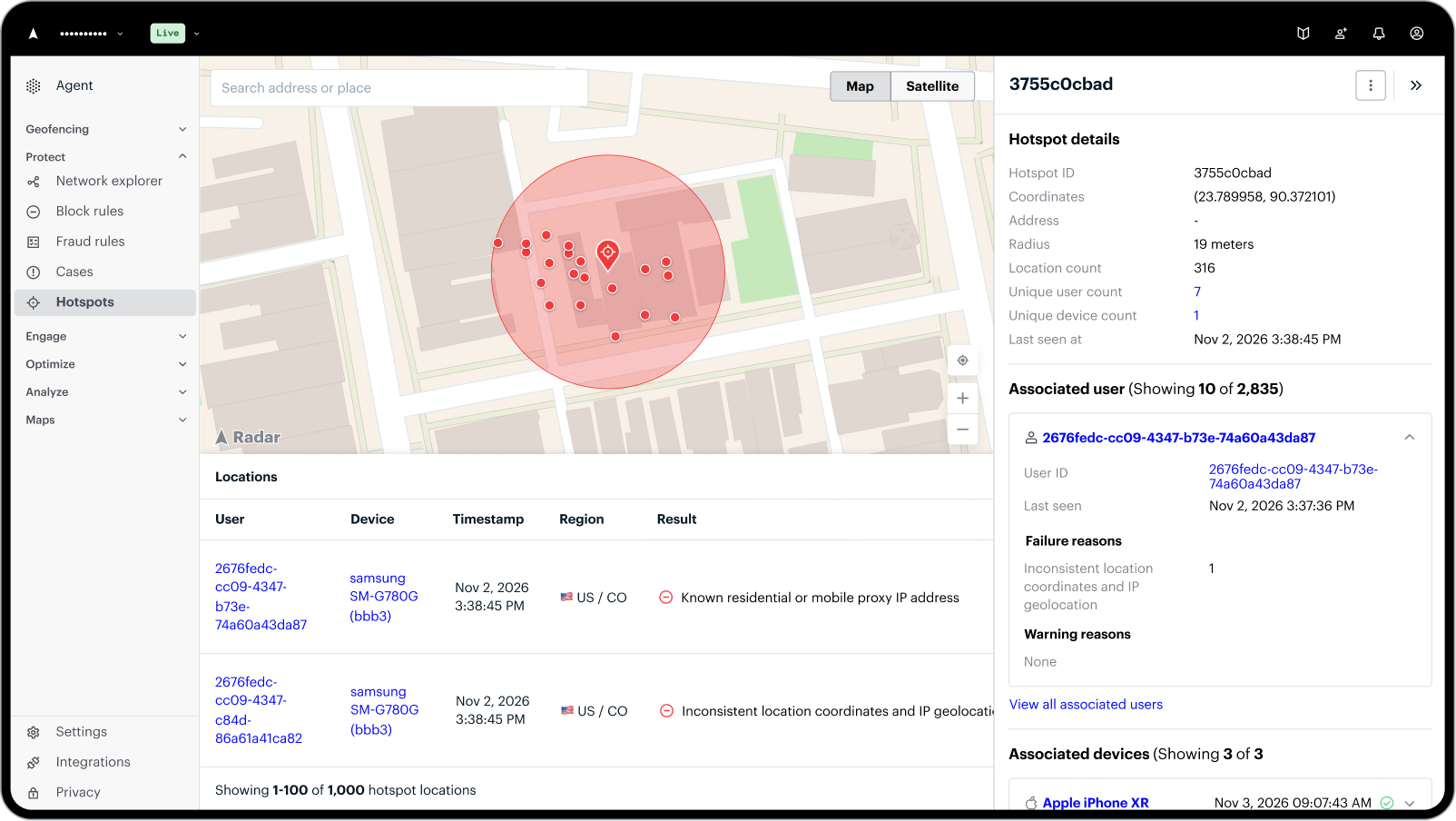
Fraud hotspot detection: Identify physical locations associated with unusually high concentrations of suspicious activity. Fraud hotspots help teams uncover coordinated fraud that might be difficult to detect through device or IP signals alone.
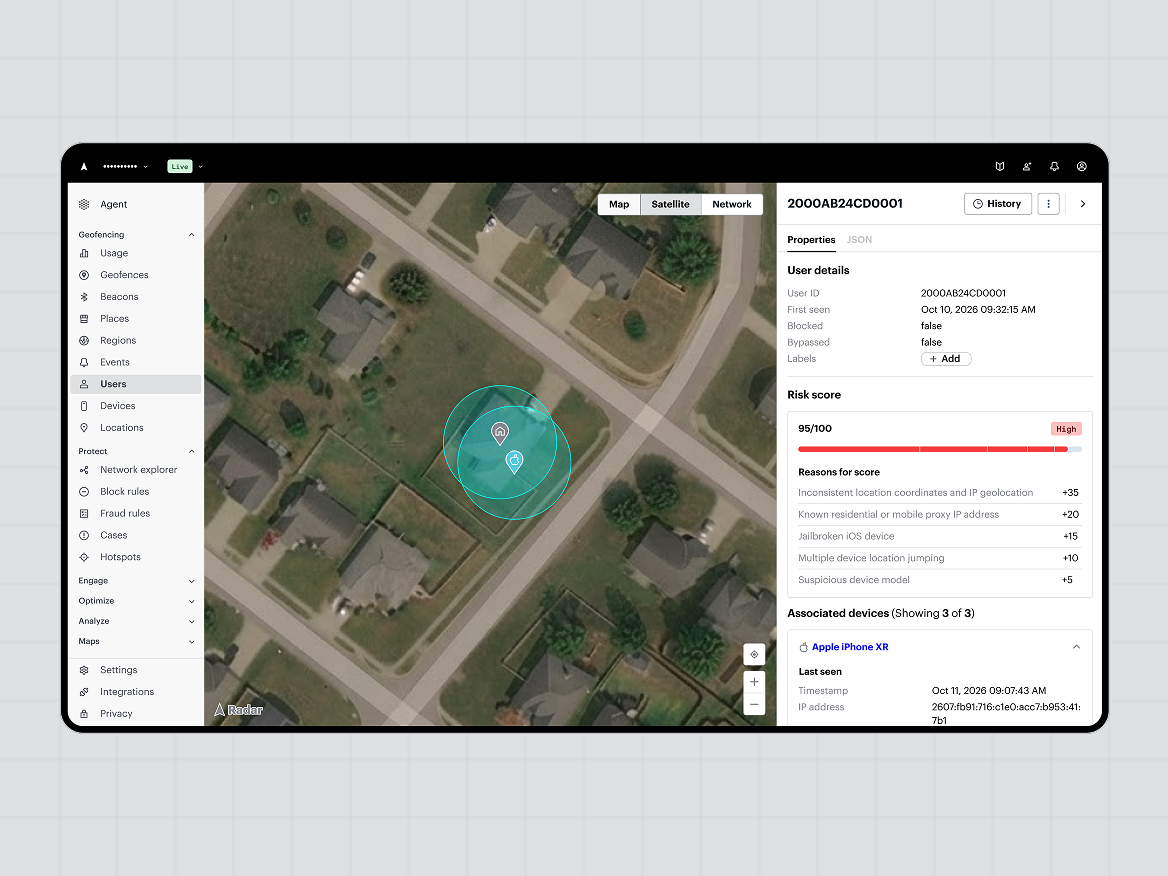
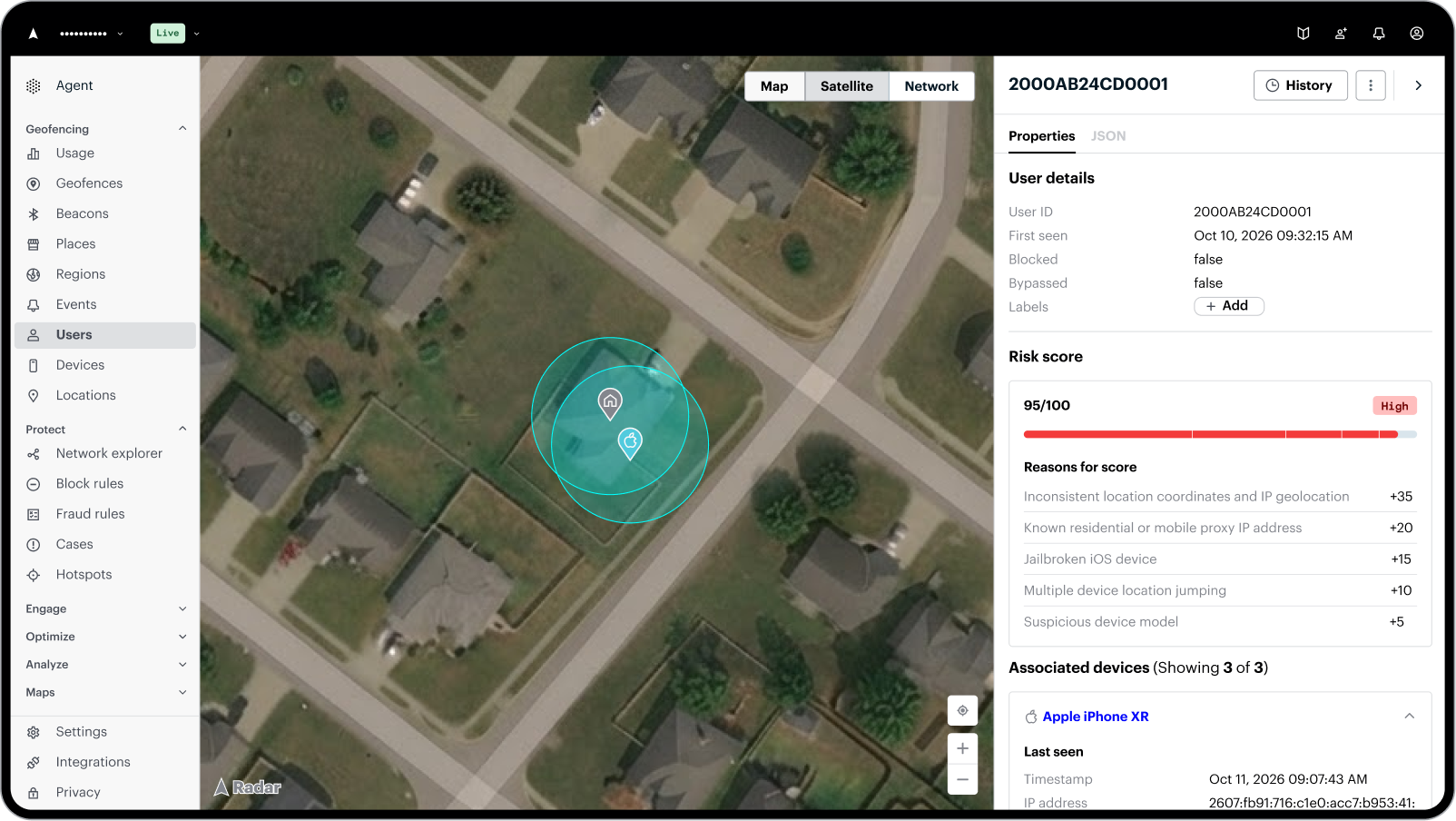
RF-1: Our new machine learning-based fraud risk model. RF-1 analyzes location, device, and network signals to generate a risk score from 0 to 100, with explanations of the factors contributing to each score.
Both capabilities make sophisticated fraud detection accessible without requiring customers to build and maintain their own machine learning models.
We're also making it easier to continuously improve fraud detection with customer feedback and historical data:
- Labels API: Identify fraudulent or legitimate users and devices to incorporate confirmed outcomes into fraud analysis.
- Suggested fraud rules: Surface recommended fraud rules based on observed patterns and labeled outcomes.
- Backtesting: Evaluate potential rules against historical activity before deploying them to production.
Network intelligence, without sharing customer data
One of the most powerful aspects of the Location Intelligence Graph is that customers can benefit from patterns observed across Radar's broader network.
For example, understanding how legitimate devices behave in different physical environments can help us identify abnormal activity, even when a particular customer hasn't encountered that pattern before.
Importantly, Radar does not share individual user or device records across customers. Instead, we use anonymized and aggregated learnings across eligible customers to improve our models and detection capabilities.
This approach lets us deliver the benefits of network intelligence while maintaining appropriate separation between customers.
Built for the world's biggest moments
From Black Friday to the Super Bowl, Radar powers mission-critical experiences where accuracy, reliability, and latency matter.
Our infrastructure handles more than 20,000 API calls per second at peak, and our Graph brings proprietary data and machine learning into real-time location and fraud decisions at that scale.
We're just getting started.
We'll continue expanding the Graph with additional proprietary datasets, machine learning models, and fraud detection capabilities. And because the Graph is built on the same underlying infrastructure that powers Radar's Maps and Geofencing Platforms, improvements in our data and intelligence benefit the entire platform.
To see the Location Intelligence Graph in action, learn more about fraud hotspots and RF-1, or talk to our team. We'll also be hosting a live session on November 19th to dive deeper into the Graph and the new fraud detection capabilities it powers. Register here.