Canada's regulated iGaming market just got a lot bigger.
On July 13, 2026, Alberta becomes the second Canadian province to open its online gambling market to private operators. Nearly 50 operators are getting licenses, including FanDuel, DraftKings, Caesars, and bet365.
Getting approved was the first step. The compliance requirements that earned them entry run continuously, and that's where the real work sits.
What changed, and why it matters
Until this year, online sports gambling in Alberta was exclusive to PlayAlberta, the province's government-run platform. Over 70% of online gambling in Alberta was happening through unregulated offshore sites, which meant the vast majority of real money wagering sat entirely outside any regulated framework.
The iGaming Alberta Act (Bill 48) changed that. Alberta modeled its approach on Ontario's open, multi-operator structure, which launched in April 2022 and has proven both commercially viable and regulatorily workable. 91% of Ontario players now choose regulated sites, up from an estimated 30% before the market opened. Alberta is aiming for the same shift.
Regulatory duties, including registration, compliance, and enforcement, fall under the AGLC. The Alberta iGaming Corporation (AiGC) handles day-to-day operations and commercial oversight.
What operators are on the hook for
Getting into Alberta was a two-step process. Operators had to complete AGLC regulatory approval first, then finalize a commercial agreement with the AiGC. Each operator paid a $50,000 application fee and an annual $150,000 per-site fee.
The compliance requirements go well beyond paperwork. Recent amendments to Alberta Gaming, Liquor and Cannabis regulations clarified licensing rules, advertising standards, and responsible gambling requirements that operators have to meet on an ongoing basis. Three of them carry most of the technical burden, and they're the ones that need real infrastructure behind them rather than a checkbox at registration.
Account sharing detection
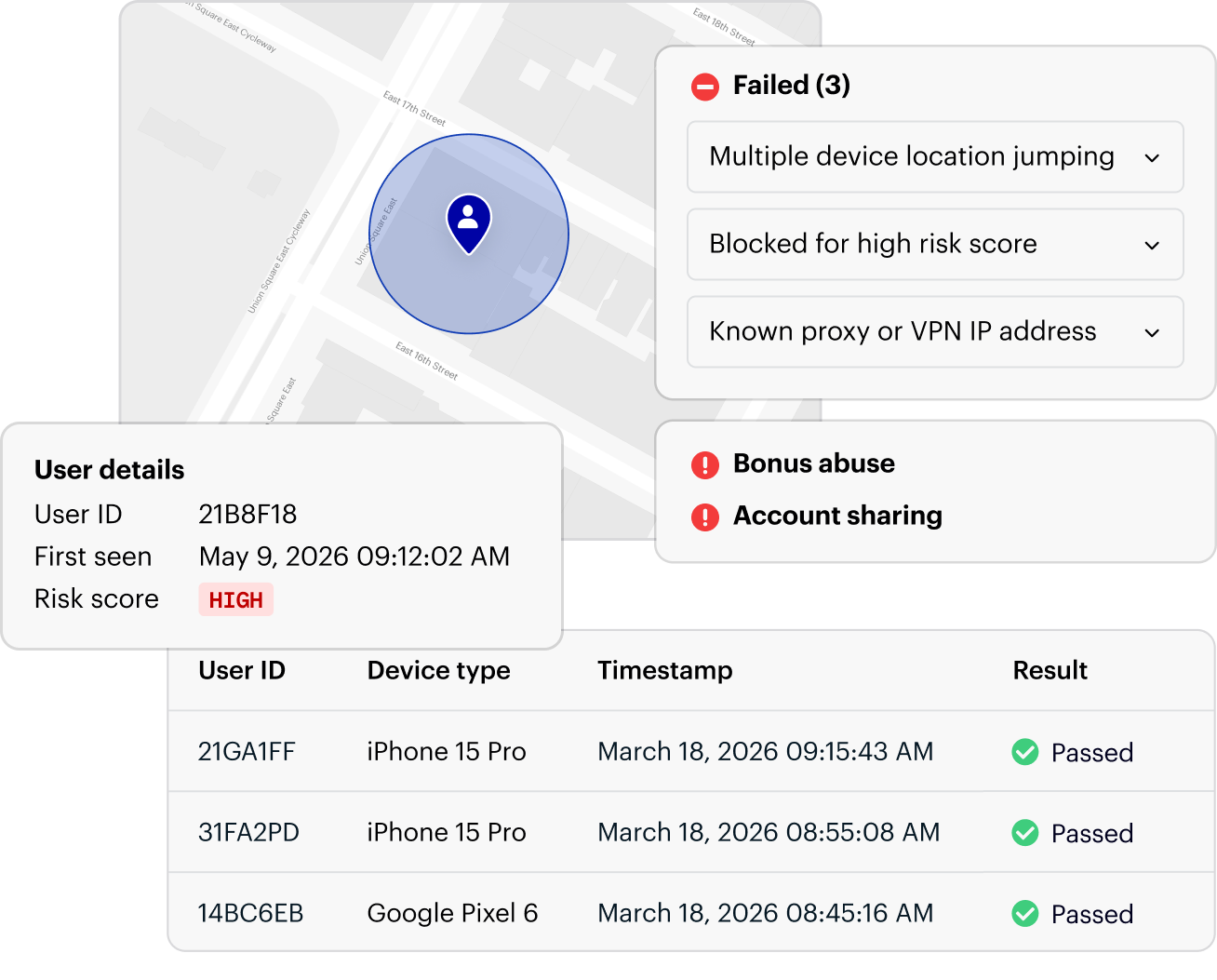
Operators have to identify when a single account is being used by more than one person, and document the reasons an account got flagged. A shared login can mean a self-excluded person playing through someone else's account, an underage user, or organized fraud running multiple seats.
Catching it isn't a credentials problem. The same username and password are being entered correctly every time. What separates one user from several is the pattern underneath: the devices in play, the locations they connect from, the rhythm of how sessions start and stop. That's device and behavioral signal work, and it's the layer most location vendors don't reach.
Sanctions and self-exclusion screening
Operators that completed registration have already started integrating with a centralized self-exclusion system. That integration is the start of the obligation, not the end of it.
Screening against self-exclusion registries and sanctions lists has to run continuously. People add themselves to exclusion programs after they've already been playing. Sanctions designations change. A check performed once at signup tells you nothing about the account six months later, which is the whole reason the registry is centralized and live rather than a file operators download once.
Why location verification is non-negotiable
A regulated iGaming market only works if operators can prove their users are actually in the province. This isn't a technicality. It's a licensing requirement with real consequences.
Every wager placed in Alberta needs to happen within Alberta's borders. For most players, that's a verification step at the moment of the bet: accurate, real-time location, geofencing at the provincial boundary, and fraud detection capable of catching VPN use and device spoofing.
Ongoing location monitoring for high-risk players
High-risk accounts are different. There the requirement is closer to monitoring than verification: watching for the VPN that switches on mid-session, the device that reports one location while the network reports another, the spoofing tools built specifically to defeat a single geolocation check.
Ontario operators ran into this after their 2022 launch. Teams that had never needed precise geolocation at scale found that the hard part wasn't the launch-day check, it was sustaining accuracy against users actively trying to beat it. Alberta operators are inheriting the same lesson on a shorter timeline.
About Radar
Radar is the geo-compliance and location intelligence platform built for regulated gaming markets. We give operators the geofencing, account sharing detection, sanctions screening, and ongoing location monitoring they need to meet Alberta's licensing requirements, not just at launch, but every day after. Trusted by leading gaming operators and suppliers across sportsbook, iGaming, iLottery, DFS, sweepstakes, and casino. If you're operating in Alberta, talk to our team.