The new standard for geo-compliance and fraud prevention
Radar is the modern, flexible geo-compliance and anti-fraud solution, priced per user instead of per check, so you can verify on every wager, deposit, and withdrawal at no additional cost.












Why teams are making the switch to Radar
The most accurate location and device signals
Radar combines GPS, Wi-Fi, IP, Bluetooth, and sensor data into a single, hard-to-fake signal that IP geolocation alone can never replicate.
Prebuilt and custom fraud detection rules
Apply prebuilt rules for spoofing, bonus abuse, and account takeover, or build your own, with accuracy precise enough to catch real fraud without blocking real users.
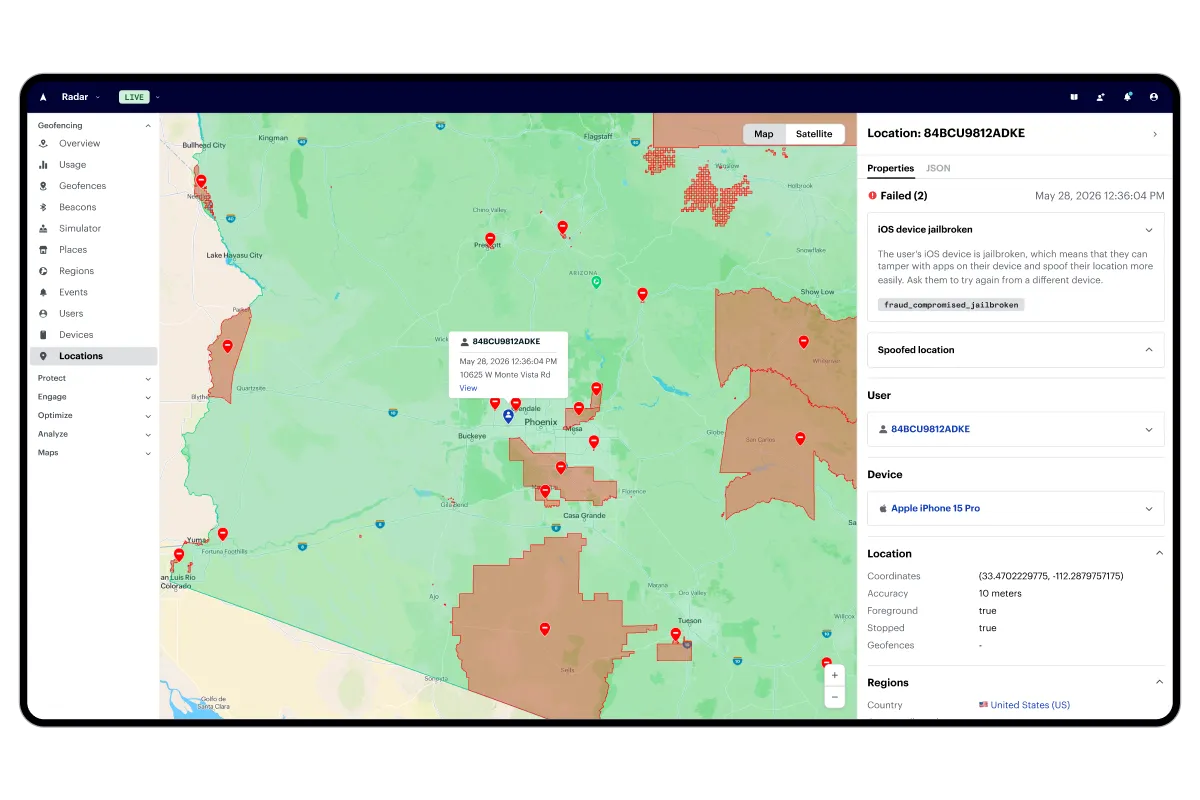
Investigate and act on fraud signals faster
Surface flagged activity, identify patterns across users and devices, and route signals into your existing fraud stack without custom development.
One platform for precise location verification and fraud prevention
Verify every user is where they need to be
Confirm that users are physically located in a licensed state or jurisdiction before every wager or transaction, with accurate, real-time location verification that meets regulatory requirements across every market you operate in.
Explore Protect →
Stop bad actors before they cost you
Identify location spoofing, VPN use, bonus abuse, and account takeovers with accuracy up to 10x better than iOS and Android defaults, reducing false positives that block real users and cost you revenue.
Explore Protect →
Onboard faster with more accuracy
Real-time address autocomplete and validation reduces signup friction and improves identity verification accuracy, so more users complete registration and your compliance data stays clean from day one.
Explore Protect →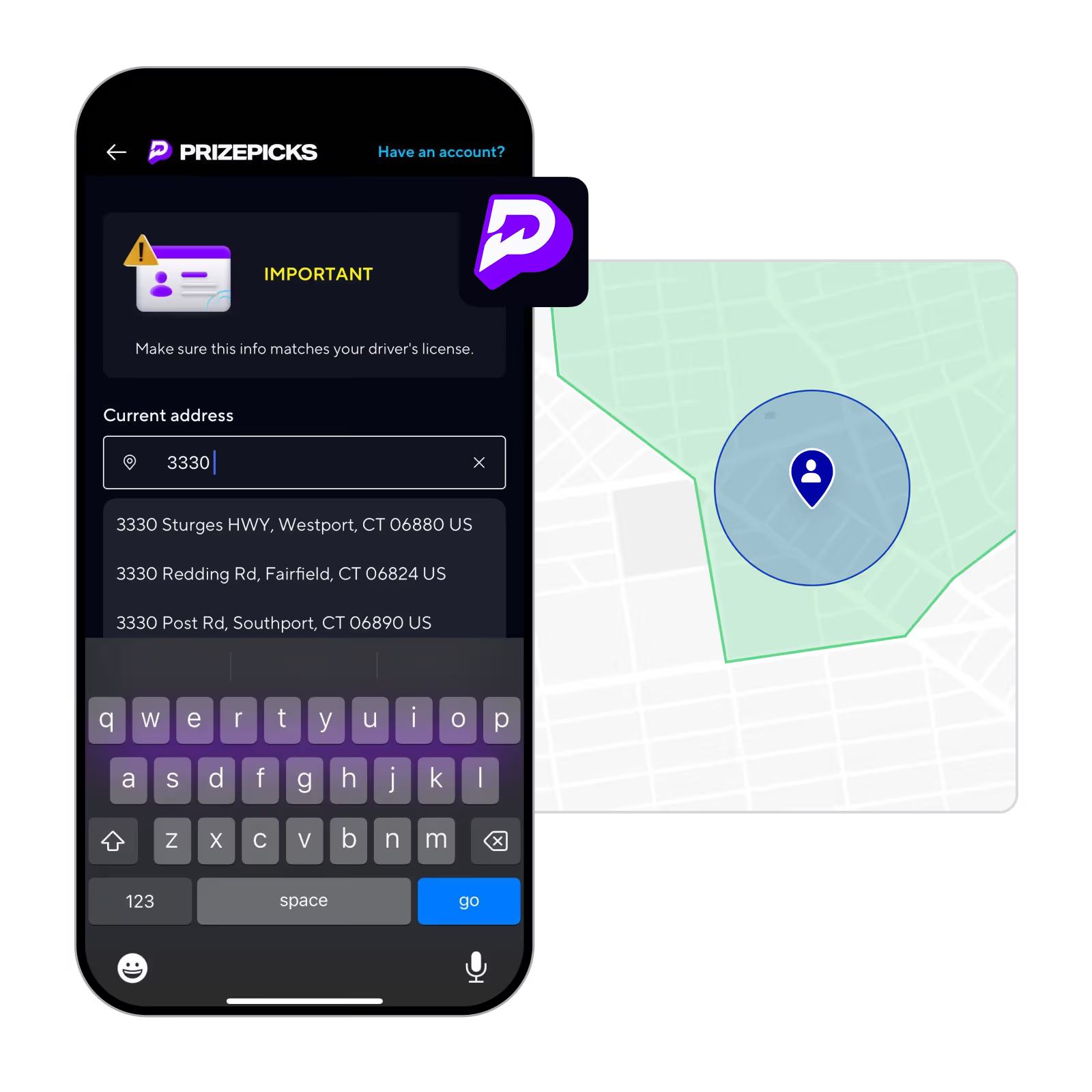
Built for the scale and compliance demands of regulated gaming
API calls per day peaking at 20K+ per second
Licenses in North American jurisdictions
tested and certified
Trusted by the world’s leading teams



The Radar difference

The most accurate, real-time location data
Radar’s SDKs and APIs collect location, device, and sensor data across GPS, Wi-Fi, IP, and more, giving you the most accurate, real-time signals in the market.

Developer-friendly by design
Modern SDKs and APIs built for fast integration. Connect to your existing stack, integrate with just a few lines of code, and ship in a single sprint.

Enterprise-grade scale and support
1 billion API calls per day and installed on hundreds of millions of devices. SOC 2 and GDPR compliant, backed by a team of location experts who support you at every step.

Cost-effective, all-in-one
Proprietary infrastructure and economies of scale make Radar more cost-effective than legacy solutions or building in-house, so you get more location for less.
Frequently asked questions
What is location-based fraud detection and how does it work?

Location-based fraud detection uses real-world GPS, Wi-Fi, Bluetooth, and device signals to verify that a user is physically where they claim to be. Unlike IP geolocation, which is easy to spoof with a VPN or proxy, location-based fraud detection cross-references multiple signals to confirm genuine physical presence and device integrity.
Radar Protect applies this approach to stop account takeovers, location spoofing, bonus abuse, and geo-compliance violations in real time. Because Radar works at the SDK level on iOS and Android, it captures the precise, hard-to-fake signals that server-side and IP-based tools miss.
How is GPS-based fraud detection different from IP geolocation?
IP geolocation estimates a user's location based on their internet connection, which is easy to manipulate using VPNs, proxies, and residential IP services. GPS-based fraud detection uses the device's actual location hardware alongside Wi-Fi, Bluetooth, and environmental signals to confirm where a user physically is.
The result is significantly more accurate and significantly harder to fake. Radar Protect combines GPS with environment fingerprinting to catch the spoofing techniques that IP-based tools from providers like MaxMind, SEON, and Sift are not designed to detect.
How does Radar detect location spoofing and VPN use?
Radar Protect detects location spoofing by cross-referencing GPS coordinates, IP address, Wi-Fi network, device sensor data, and behavioral patterns to identify when a reported location is inconsistent with what the device is actually doing. This catches GPS spoofing apps, VPN and proxy services including residential proxies, device tampering, emulators, and device farms. Because Radar checks multiple signals simultaneously rather than relying on any single source, it catches sophisticated spoofing techniques that fool IP-only or GPS-only checks. Radar's mobile SDKs have been independently audited and certified by Gaming Labs International (GLI) for gaming use cases, and apply the same detection logic across every industry.
What industries use Radar Protect?
Radar Protect is used across any industry where location and device integrity are critical to fraud prevention and compliance. Current use cases include food delivery and ride sharing (fake couriers, spoofed pickups, bonus abuse), peer-to-peer payments and neobanks (mule accounts, impossible travel, account takeovers), gaming and betting (geo-compliance, location spoofing, bonus abuse), retail and e-commerce (promo abuse, bot operators, refund scams), and financial services (impossible travel, KYC accuracy, account integrity). Radar wins fastest where the app already uses GPS and where fraudsters depend on location spoofing and device farms.
How does Radar Protect complement existing fraud tools like Sift or SEON?
Radar Protect adds a precise location and device signal layer that complements, rather than replaces, existing fraud tools. Platforms like Sift and SEON are built primarily on behavioral analytics, IP scoring, and device fingerprinting, signals that are increasingly easy to fake as privacy restrictions tighten and spoofing techniques grow more sophisticated. Radar fills that gap with GPS-level location accuracy, environment fingerprinting, and real-time spoofing detection that server-side tools cannot replicate. Most teams integrate Radar alongside their existing fraud stack, routing Radar's location signals into their existing rules engine or risk scoring model.